

Research Bio
Daniel A. Farber is a legal scholar whose research focuses on constitutional law, environmental law, and statutory interpretation. He has done extensive work on climate change law and policy, analyzing the constitutional and administrative frameworks that govern environmental protection. Farber’s scholarship integrates legal analysis with policy studies, offering insights into how law can address complex problems such as climate adaptation and disaster resilience. He has also written widely on constitutional theory, free speech, and legal history, including legal casebooks in constitutional law and in environmental law.
Farber is the Sho Sato Professor of Law at UC Berkeley, where he also serves as Faculty Director of the Center for Law, Energy & the Environment. He is the author of numerous books, including most recently, *Contested Ground: Understanding the Limits of Presidential Power" and *Climate Change Law*, and his articles have appeared in top law reviews. Farber is an elected member of the American Academy of Arts & Sciences and has received awards for contributions to environmental law and scholarship. He is a frequent commentator on legal and policy issues related to climate change and constitutional governance.
Research Expertise and Interest
environmental law, constiutional law, freedom of speech
In the News
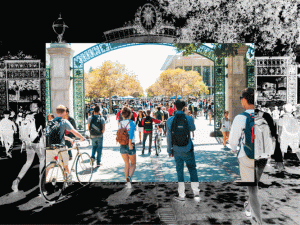
Berkeley Leaders, Scholars React to Supreme Court’s Decision on Affirmative Action

Abortion, Climate, Guns and Religion: Supreme Court Poised for a Sharp Right Turn

New Report Shows How California Can Improve Water Rights
The Center for Law, Energy & the Environment (CLEE) has drafted a new report that describes how California allocates water and identifies changes that would help the current system adapt to climate change. Co-written by Dan Farber, Deborah Lambe ’95, and UC Berkeley economist Michael Hanemann, the report focuses on practical, politically feasible measures.
Prop. 23 Creates Legal Turmoil, Cuts State Revenue, Reduces Job Growth
An independent analysis of Proposition 23 says the initiative would create legal uncertainty, reduce California state revenue, and jeopardize new and existing clean energy jobs. The white paper, released today by UC Berkeley School of Law's Center for Law, Energy & the Environment, reports Prop. 23 would also slow California's efforts to reduce climate change and could have a domino effect on other states.
Teaching
Torts [LAW 201 - 004]
Business Torts [LAW 201S - 001]
Advanced Writing Project [LAW 206.51S - 001]
Torts [LAW 201 - 003]