

Research Bio
Raffaella Margutti’s research is positioned in the new field of Multi-Messenger Astrophysics with Gravitational Waves. Margutti and her research team utilize observations of the most violent Transient Astrophysical Phenomena in the Universe, including stellar eruptions, stellar explosions, mergers of neutron stars and black holes, as well as stellar tidal disruptions by supermassive black holes. Margutti investigates the physics of these events by combining panchromatic observations across the entire electromagnetic spectrum (i.e. gamma-rays, X-ray, UV, optical, IR, and radio) with information extracted from other messengers, like gravitational waves. The primary goal of her research is to understand the nature of the physical processes that regulate such dramatic displays.
Raffaella Margutti received her undergraduate degree in Astrophysics in 2006 (magna cum laude), and her PhD in Physics and Astronomy from the University of Milano Bicocca in 2010. Margutti is a Sloan Fellow in Physics (2019), a CIFAR global scholar in Gravity and the Extreme Universe (2019), and received the 2022 New Horizons in Physics Prize for leadership in laying foundations for electromagnetic observations of sources of gravitational waves, and leadership in extracting rich information from the first observed collision of two neutron stars.
Research Expertise and Interest
astrophysics, compact object mergers, core-collapse supernovae, gamma-ray bursts, Neutron Stars, radio astronomy, space astrophysics, stellar evolution, supernova shockwaves, supernovae, tidal disruption events
In the News
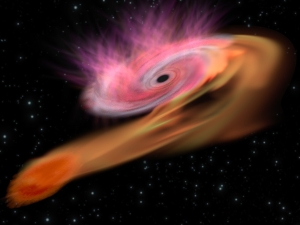
Not One, but Two Massive Black Holes Are Eating Away at This Galaxy
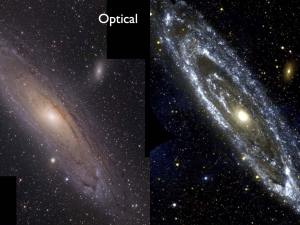
UC Berkeley Will Manage $300 Million NASA Mission To Map the UV Universe
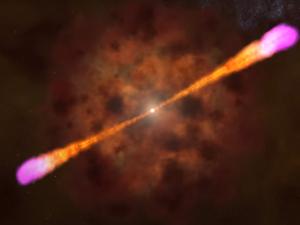
Bright Gamma Ray Burst Confounds Models of Black Hole Birth
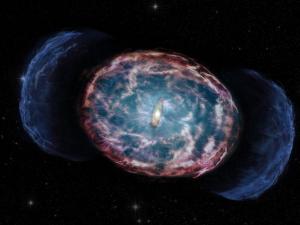
Did Rapid Spin Delay 2017 Collapse of Neutron Stars Into Black Hole?
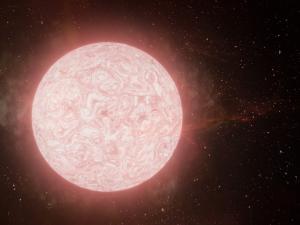
Astronomers See Death Throes of Giant Star Before Violent Explosion
Teaching
Directed Group Study [ASTRON 198]
Supervised Independent Study and Research [ASTRON 199]
Advanced Study and Research [ASTRON 299]
Special Study for Honors Candidates [ASTRON H195]
Supervised Independent Study and Research [ASTRON 199]
Advanced Study and Research [ASTRON 299]
Astronomy Colloquium [ASTRON 700]
High Energy Astrophysics [ASTRON C254]
Special Study for Honors Candidates [ASTRON H195]
High Energy Astrophysics [PHYSICS C254]
Supervised Independent Study and Research [ASTRON 199]
Stellar Structure and Evolution [ASTRON 252]
Advanced Study and Research [ASTRON 299]