
Research Bio
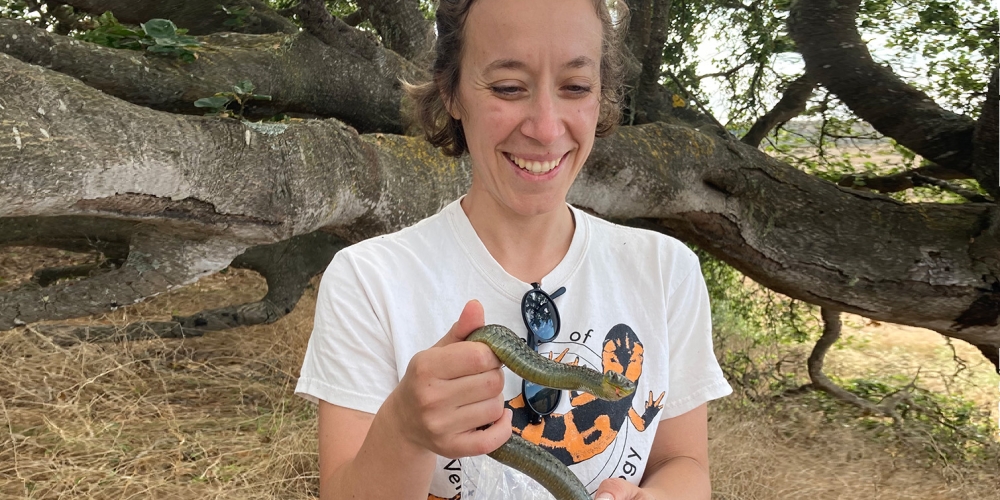
Rebecca Tarvin's research aims to understand the genetic basis of novel phenotypes by studying animals that consume and/or sequester neurotoxins. Her research employs complementary approaches in model and non-model systems, including methods in genomics and molecular biology, as well as lab experiments, to characterize unique and convergent molecular mechanisms related to toxin manipulation. Results contribute new insight into diseases that involve mutations in ion channels, and provide a unique perspective for the design of pharmaceuticals that evade xenobiotic metabolism and leverage potential toxin transport mechanisms. Dr. Tarvin and her group are also interested more generally in amphibian physiology and genomics, contributing to our knowledge of biodiversity and the unique adaptations that have allowed amphibians to prosper for more than 200 million years on earth. She has worked in Central and South America since 2010, studying biology and evolution in collaboration with local scientists, especially from Ecuador and Colombia. In addition to the study of molecular evolution, genomics, the biology of toxic animals, and the training of the next generation of scientists, her lab is deeply committed to holistic mentoring approaches and collaborative, ethical science, aims that dovetail with productive scientific teams.
Dr. Tarvin is a professor in the Department of Integrative Biology and Curator of Herpetology at the Museum of Vertebrate Zoology at the University of California Berkeley. She holds a PhD in Biological Sciences from the University of Texas at Austin and a Bachelor of Arts in Biology from Boston University.
Research Expertise and Interest
natural history, molecular genomics, phylogenetics, amphibians, chemical ecology, evolutionary ecology, evolutionary biology, adaptation, evolution, molecular evolution, physiology, molecular phylogenetics, educational equity, biodiversity, diversity of team members, equity and inclusion in academia, decolonization, collaboration, reptiles, Drosophila, genomes, evolution of novelty, conservation, nudibranchs
In the News
In Pursuit of a Poison Frog — and a Culturally Appropriate Name

Machine Translation Could Make English-Only Science Accessible to All
Losing Amphibian Diversity Also Means Losing Poison Diversity
Teaching
Natural History of the Vertebrates with Laboratory [INTEGBI 104LF]
Directed Undergraduate Research [INTEGBI 191]
Supervised Internship [INTEGBI 197]
Supervised Independent Study and Research [INTEGBI 199]
Special Study in Integrative Biology [INTEGBI 298]
Graduate Research [INTEGBI 299]
The Animal In You: Evolutionary Traces In The Human Body [INTEGBI 38]
Supervised Independent Study and Research [INTEGBI 99]
Thesis Course [INTEGBI H196A]
Thesis Course [INTEGBI H196B]
Supervised Research: Biological Sciences [UGIS 192C]
Practical Genomics [INTEGBI 134L]
Directed Undergraduate Research [INTEGBI 191]
Supervised Independent Study and Research [INTEGBI 199]
Seminar on Biology of Amphibians and Reptiles [INTEGBI 234]
Special Study in Integrative Biology [INTEGBI 298]
Graduate Research [INTEGBI 299]
Thesis Course [INTEGBI H196A]
Supervised Research: Biological Sciences [UGIS 192C]
Supervised Internship [INTEGBI 197]
Supervised Independent Study and Research [INTEGBI 199]
Supervised Independent Study and Research [INTEGBI 199]
Directed Undergraduate Research [INTEGBI 191]
Supervised Independent Study and Research [INTEGBI 199]
Seminar on Biology of Amphibians and Reptiles [INTEGBI 234]
Special Study in Integrative Biology [INTEGBI 298]
Special Study in Integrative Biology [INTEGBI 298]
Graduate Research [INTEGBI 299]
Supervised Independent Study and Research [INTEGBI 99]
Thesis Course [INTEGBI H196A]
Thesis Course [INTEGBI H196B]
Supervised Research: Biological Sciences [UGIS 192C]