

Research Bio
Helen Bateup is a neuroscientist whose research probes how intracellular signaling and synaptic plasticity shape neural circuit development and behavior. She has a particular interest in syndromic neurodevelopmental disorders, which are associated with epilepsy, intellectual disability, and autism spectrum disorder. To elucidate disease mechanisms for these disorders, her lab uses genetic mouse and human cellular models in combination with a variety of techniques that address molecular, electrophysiological, and behavioral alterations. Bateup's discoveries are providing a mechanistic understanding of how disease-associated mutations affect the biology and physiology of neurons and glia, and how altered neuronal activity impacts circuit function and behavior. In addition, her work is defining the early developmental alterations that contribute to neurodevelopmental disorders using human brain organoid models.
Bateup is an Associate Professor in UC Berkeley’s Departments of Neuroscience and Molecular & Cell Biology and a member of the Helen Wills Neuroscience Institute. Her publications appear in Nature Medicine, Neuron, Nature Communications, and eLife. She has received the Alfred P. Sloan Research fellowship in Neuroscience, a NARSAD Young Investigator Award, and the Rose Hills Innovator Award. She has also been awarded Investigatorships from the Chan Zuckerberg Biohub and Weill Neurohub. At UC Berkeley, Bateup teaches neurodevelopment and the neurobiology of disease and mentors trainees in cellular and molecular neuroscience.
Research Expertise and Interest
molecular and cellular neuroscience, neurodevelopmental disorders, autism, epilepsy, Parkinson's disease
In the News

Food Insecurity Has Lasting Impacts on the Brains and Behavior of Mice
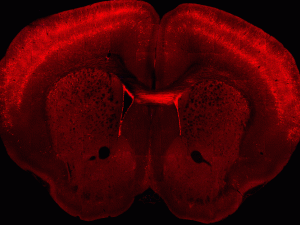
Neuroscientists roll out first comprehensive atlas of brain cells
$14 million boost for Parkinson’s disease research
NIH awards UC Berkeley $7.2 million to advance brain initiative
The National Institutes of Health today announced its first research grants through President Barack Obama’s BRAIN Initiative, including three awards to the University of California, Berkeley, totaling nearly $7.2 million over three years.
Teaching
Research Review in Neurobiology: Molecular Mechanisms of Neuronal Plasticity [MCELLBI 269C - 001]
Research [MCELLBI 292 - 033]
Neuroscience Graduate Research [NEU 292 - 002]
Neuroscience Research Review [NEU 295 - 002]
Survey of Neuroscience Research [NEU 77 - 001]
Research Review in Neurobiology: Molecular Mechanisms of Neuronal Plasticity [MCELLBI 269C - 001]
Research [MCELLBI 292 - 033]
Neurodevelopment [NEU 164 - 001]
Neuroscience Graduate Research [NEU 292 - 002]
Neuroscience Research Review [NEU 295 - 002]
Research Review in Neurobiology: Molecular Mechanisms of Neuronal Plasticity [MCELLBI 269C - 001]
Research [MCELLBI 292 - 033]
Neuroscience Graduate Research [NEU 292 - 002]
Neuroscience Research Review [NEU 295 - 002]