
Research Bio
Molecular Engineering of Single-Site Solid Catalysts and Functional Materials
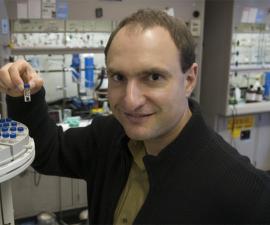
The Katz Group is a catalysis group that focuses on understanding how catalysts functions given a certain molecular active-site structure. This approach enables and is invaluable to the rational design of catalysts for emerging applications. These applications require catalysts of high activity and selectivity whereas conventional approaches often optimize one at the expense of the other. Our group is currently active in four areas:
- Grafted metallocalixarene sites on inorganic-oxide surfaces, where the calixarene enforces site isolation as well as an optimized coordination geometry surrounding the metal atom;
- Supported molecular metal clusters bound with calixarenes, where the calixarene enforces accessibility to open sites on the metal surface while preventing aggregation via coalescence;
- Use of weak-acid sites on surfaces for biomass depolymerization, where high activity, selectivity, and lack of leaching even in the presence of metal salts can be obtained in a manner not possible with strong acids; and
- Delaminated zeolites, where the high external surface area enables reactions with bulky molecules that conventionally could not fit inside a zeolitic micropore. The role of the zeolite framework in these materials is to template a preferential coordination environment surrounding a Lewis-acid metal heteroatom site for catalysis, which cannot be accomplished with conventional amorphous materials, which lack framework rigidity and order of the crystalline material.
They are also active in a fifth area that deals with assembly of complex organic-inorganic interfaces, which are geared for stabilizing systems that are applicable to coatings.
Research Expertise and Interest
chemical engineering, nanoengineering, catalytic imprinted silicas, catalysts in biological systems, catalysis, chemical sensing
In the News

Watch: How to Enjoy Gel Nails Without Fear of UV Skin Damage

How to Protect Against UV Rays During a Manicure

Katz Mimics Nature to Improve Synthetic Catalysts
Inspired by how enzymes work in nature’s biological processes, CBE professor Alex Katz and colleagues have demonstrated a way to improve control of synthetic catalysts.
Teaching
Seminars for Graduate Students [CHEM 298 - 031]
Research for Graduate Students [CHEM 299 - 036]
Seminars for Graduate Students [CHEM 298 - 025]
Research for Graduate Students [CHEM 299 - 033]