
Research Bio
Roland Bürgmann is a geophysicist whose research investigates crustal deformation, earthquakes, and the mechanical behavior of the lithosphere. Using geodesy, satellite remote sensing, and field observations, his work reveals how tectonic stresses accumulate and are released through faulting and crustal deformation. He is best known for pioneering applications of InSAR and GPS technologies to measure strain and model earthquake cycles, contributing to improved hazard assessment and understanding of plate boundary processes. He also uses these tools to study the dynamics of landslides, land subsidence and volcanic processes.
He is Professor in the Department of Earth and Planetary Science and the Seismology Lab at UC Berkeley and a Faculty Scientist at Lawrence Berkeley National Laboratory, where he leads research on crustal dynamics and tectonic processes.
Research Expertise and Interest
active tectonics, geophysics, geology, earth and planetary science, geomechanics, tectonics, Seismology, structural geology, fault zone processes, crustal deformation, space geodesy, natural hazards, landslides
In the News

UC Berkeley Professors Named AAAS Fellows

Five Berkeley faculty members elected fellows of the AAAS
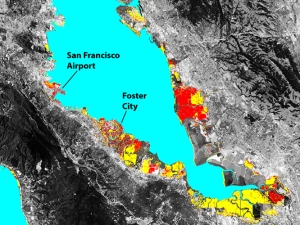
Sinking land will exacerbate flooding from sea level rise in Bay Area
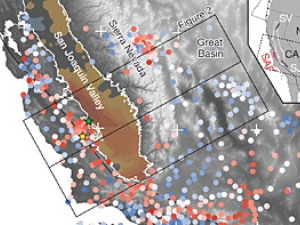
Central Valley groundwater depletion raises Sierra and may trigger small earthquakes
Winter rains and summer groundwater pumping in California’s Central Valley make the Sierra Nevada and Coast Ranges sink and rise by a few millimeters each year, creating stress on the state’s earthquake faults that could increase the risk of a quake.

Tabletop fault model reveals why some quakes lead to faster shaking
The more time it takes for an earthquake fault to heal, the faster the shake it will produce when it finally ruptures, according to a new study by engineers at the University of California, Berkeley.
Project will monitor tremor activity beneath San Andreas Fault
The Gordon and Betty Moore Foundation has donated $1.2 million to the Berkeley Seismological Laboratory to install a small network of earthquake sensors around the San Andreas Fault at Cholame to monitor faint tremors that have been discovered in the area.
Featured in the Media
Teaching
Research [EPS 280 - 006]
Seminar [EPS 290 - 001]
Supervised Research: Physical Sciences [UGIS 192D - 010]
Active Tectonics [EPS 216 - 001]
Research [EPS 280 - 006]
Seminar [EPS 290 - 001]
Supervised Research: Physical Sciences [UGIS 192D - 031]
Advanced Topics in Seismology and Geophysics [EPS 254 - 001]
Research [EPS 280 - 006]
Seminar [EPS 290 - 001]
Earthquakes in Your Backyard [EPS C20 - 001]
Earthquakes in Your Backyard [LS C70Y - 001]
Supervised Research: Physical Sciences [UGIS 192D - 008]