

Research Bio
Liwei Lin is a pioneering researcher in microelectromechanical systems (MEMS), whose work has significantly advanced the design and manufacturing of tiny sensors and actuators used in medical devices, consumer electronics, and energy systems. His research bridges mechanical engineering and nanotechnology to create devices that interface the physical and digital worlds at microscopic scales. Lin has made foundational contributions to the fabrication of microscale structures using techniques such as silicon surface/bulk micromachining and micro molding processes.
Best known for developing innovative MEMS-based energy harvesters and biomedical sensors, Lin’s work enables self-powered devices and point-of-care diagnostic tools. His research has facilitated breakthroughs in wearable technologies, implantable sensors, and sustainable microsystems.
An expert in micro/nanofabrication and MEMS design, Lin is a professor in the Department of Mechanical Engineering at the University of California, Berkeley. He also serves as Co-Director of the Berkeley Sensor & Actuator Center, a leading research consortium in MEMS innovation. Lin is a Fellow of the ASME and has received numerous honors for his scholarly impact, including the NSF CAREER Award and multiple Best Paper Awards from international conferences.
Research Expertise and Interest
nanotechnology, mems (microelectromechanical systems), nems (nanoelectromechanical systems), design and manufacturing of microsensors, microactuators, development of micromachining processes, silicon surface/bulk micromachining, micromolding process
In the News

From COVID to Cancer, At-Home Test Spots Disease With Startling Accuracy

UC Berkeley Engineers Create World’s Smallest Wireless Flying Robot

Bakar Fellows Program Names Seven New Spark Award Recipients
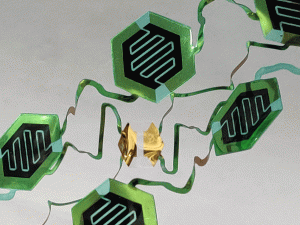
Slicing the Way to Wearable Sensor Prototypes

Insect-Sized Robot Navigates Mazes With the Agility of a Cheetah
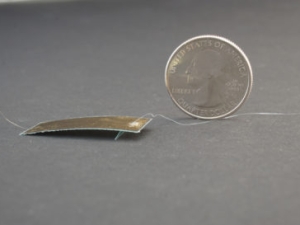
You Can’t Squash This Roach-Inspired Robot

Researchers Use Jiggly Jell-O to Make Powerful New Hydrogen Fuel Catalyst

Berkeley Engineers Develop Origami Electronics From Cheap, Foldable Paper
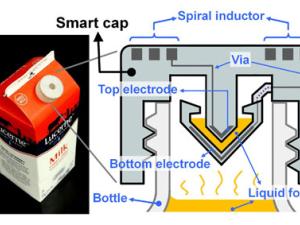
3D-Printed ‘Smart Cap’ Uses Electronics to Sense Spoiled Food
It might not be long before consumers can just hit “print” to create an electronic circuit or wireless sensor in the comfort of their homes. UC Berkeley engineers are expanding their portfolio of 3D printing technology to include electrical components, such as resistors, inductors, capacitors and integrated wireless electrical sensing systems.
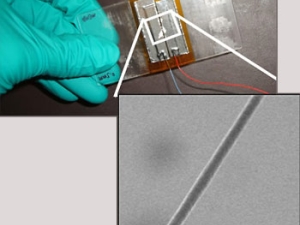
New Fiber Nanogenerators Could Lead to Electric Clothing
In research that gives literal meaning to the term "power suit," UC Berkeley engineers have created energy-scavenging nanofibers that could one day be woven into clothing and textiles. The technology could eventually lead to wearable 'smart clothes' that can power hand-held electronics through ordinary body movements.
Featured in the Media
Teaching
Introduction to MEMS (Microelectromechanical Systems) [MECENG 119 - 001]
Introduction to Microelectromechanical Systems [MECENG 219 - 001]
Group Studies, Seminars, or Group Research [MECENG 298 - 017]
Individual Study or Research [MECENG 299 - 017]
Introduction to Nanotechnology and Nanoscience [MECENG 118 - 001]
Introduction to Nanotechnology and Nanoscience [MECENG 218N - 001]
Group Studies, Seminars, or Group Research [MECENG 298 - 018]
Individual Study or Research [MECENG 299 - 018]
Introduction to MEMS (Microelectromechanical Systems) [MECENG 119 - 001]
Introduction to Microelectromechanical Systems [MECENG 219 - 001]
Group Studies, Seminars, or Group Research [MECENG 298 - 017]
Individual Study or Research [MECENG 299 - 017]