

Research Bio
Michael Jordan is the Pehong Chen Distinguished Professor in Electrical Engineering and Computer Sciences and a professor of Statistics and Computer Sciences. His research focuses on the relationships between computation, statistics, and economics. He also works on applications in molecular biology, natural language processing, signal processing and mechanism design. Specific areas of focus in recent years include convex and nonconvex optimization theory, gradient-based stochastic processes, variational inequalities, and statistical contract theory.
Research Expertise and Interest
computer science, artificial intelligence, computational biology, statistics, machine learning, electrical engineering, applied statistics, optimization
In the News
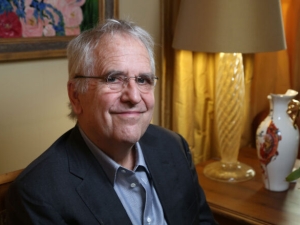
Michael I. Jordan Receives Frontiers of Knowledge Award

How to Use AI for Discovery — Without Leading Science Astray

UC Berkeley Launches Sky Computing Lab to Revolutionize the Cloud Industry

EECS Professor Michael Jordan Named to Royal Society
$10 Million for Berkeley RISELab’s AI Research
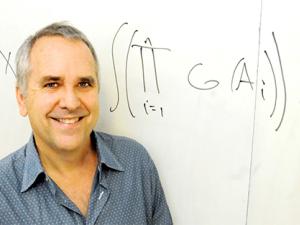
Big Thinking About Big Data
To Michael Jordan, the smart way to extract and analyze key information embedded in mountains of “Big Data” is to ignore most of it. Instead, zero in on collections of small amounts of data.
Three Faculty Members Elected to American Academy of Arts and Sciences
Sociologist Claude Fischer, cognitive scientist Michael Jordon and theoretical chemist Martin Head-Gordon have been elected members of the American Academy of Arts and Sciences.
Three UC Berkeley Professors Named to National Academy of Sciences
Two University of California, Berkeley, faculty members were elected members of the National Academy of Sciences (NAS) and a third professor was elected a foreign associate.
Featured in the Media
Teaching
Individual Study Leading to Higher Degrees [STAT 299 - 016]
Individual Research [CPH 299 - 008]
Individual Study Leading to Higher Degrees [STAT 299 - 014]
Individual Study Leading to Higher Degrees [STAT 299 - 016]