
Research Bio
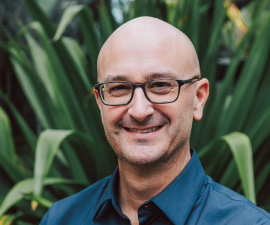
David Shuster is a professor in Earth and Planetary Science at UC Berkeley. His group is interested in geologic processes and phenomena that occur primarily at and near the surfaces of Earth, Earth's moon and Mars. They study the timescales of such phenomena using observations of radiogenic and cosmogenic nuclides measured in our labs. The questions that they address span orders of magnitude in space and time, ranging from the development of mountain topography during the Pleistocene to processes leading to magnetic fields recorded in early solar system condensates. Their research is ultimately motivated by outstanding questions and problems in earth and planetary science. Because observational tools are often not available to address these question and related phenomena that occurred over geologic timescales, much of their effort is focused on developing an understanding of the basic chemistry and physics of geochemical systems in order to develop new sets of observations. Prof. Shuster currently serves as a Participating Scientist and a Long Term Planner on the Mars 2020 Perseverance rover mission, focused on sample collection.
Research Expertise and Interest
noble gas geochemistry, thermochronometry, cosmogenic nuclide, alpine glacial erosion, chemical weathering, lunar impacts, magnetism, martian meteorites, mars 2020 perseverance rover mission
In the News
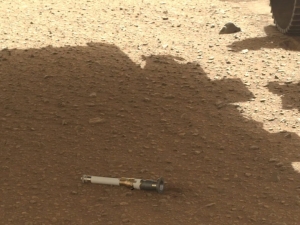
Rocks Collected on Mars Hold Key to Water and Perhaps Life on the Planet
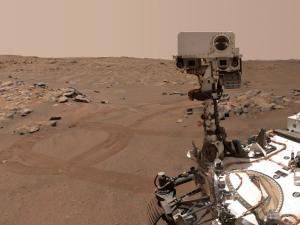
Perseverance Rover Retrieves Key Clues to Mars’ Geologic and Water History
Teaching
Geochemistry [EPS 131 - 001]
Research [EPS 280 - 036]
Research [EPS 280 - 035]
The Planet Earth [EPS 50 - 001]
Geochemistry [EPS 131 - 001]
Research [EPS 280 - 036]
Directed Group Study for Graduates [EPS 298 - 006]