
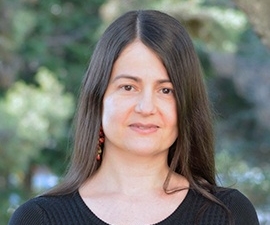
Research Bio
Céline Pallud investigates the transport and biogeochemical processes that determine how nutrients and contaminants cycle through soils, sediments, and aquatic systems. Her research integrates laboratory experiments, field studies, and reactive transport modeling to understand how microbial activity, soil characteristics, mineral composition, and environmental and redox conditions control the fate and mobility of elements such as arsenic, carbon, iron, nitrogen, sulfur and selenium. She is best known for her mechanistic studies of microbe-mineral interactions that influence contaminant cycling and soil health. Pallud’s interdisciplinary approach connects fundamental environmental microbiology and geochemistry with applied modeling to predict how natural systems respond to disturbances and to develop strategies to manage soils in a sustainable way.
She is Professor in the Department of Environmental Science, Policy, and Management at UC Berkeley, where she leads the Soil and Environmental Biogeochemistry Laboratory and teaches courses in soil science, soil pollution & remediation, and soil microbiology & (bio)geochemistry. Her work provides critical insight into sustaining soil and water quality under changing environmental conditions.
Research Expertise and Interest
biogeochemistry, iron reduction, metals and contaminants, soil aggregates, selenium, selenium kinetics of organic matter degradation, nitrate reduction, soil and environmental biogeophysics, biogeochemical cycles, fate and transport of nutrients, sulfate reduction, wetland soils, littoral sediments, spatial variation in biogeochemical processes, phytoremediation, soil health, photovoltaic farm, soil remediation
Teaching
Science of Soils [ESPM 120 - 001]
Soil Microbiology and Biogeochemistry [ESPM 131 - 001]
Individual Research [ESPM 299 - 056]
Individual Research [ESPM 299 - 056]