
Research Bio
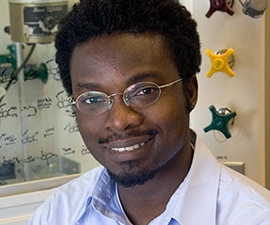
Richmond Sarpong is a professor in the Department of Chemistry. Central to his research group's interests is the total synthesis of natural products with a keen eye toward the development of new synthetic methods and strategies. In concert with this general program, they look to nature to inspire our choice of synthetic targets (natural products) and some of our strategies (e.g., bio-mimetic approaches) to natural product synthesis. The compounds that they synthesize in their laboratory may ultimately become important as tools to study biological systems or provide a starting point for the development of therapeutics. The challenge of a total synthesis provides a unique opportunity to test the limits of synthetic methodology and to invent new reactions. The formation of carbon-carbon bonds (C-C bonds) is of fundamental importance to synthetic organic chemistry. His group seeks to address some of the current limitations in synthetic organic chemistry by defining new directions for C-C bond formation and then validating our methodology in the arena of complex molecule synthesis. In this regard, they are interested in (A) C-C bond forming processes that are coupled with the energetically 'downhill' events of strain release and aromatization to provide new strategies to access natural product motifs, (B) the generation of metal vinylidenes under mild reaction conditions as a new entry into C-H functionalization and (C) novel access to reactive intermediates such as metallo-carbenoids and radicals. Ultimately, they anticipate that their interests will evolve, depending on a student's interest or fascinating new transformations that they encounter. Among the natural products currently of interest in his group are the teleocidin B family of indole alkaloids (potent protein kinase C tumor promoters), the cyathane diterpenoids scabronine A and erinacine E (active stimulants of nerve growth factor biosynthesis) and the trichothecane sesquiterpenoids verrucarin A and satratoxin H which are mycotoxins that also possess cytotoxic properties.
Research Expertise and Interest
organic and organometallic chemistry
In the News

Eleven UC Berkeley Faculty Members Elected Fellows
Nine faculty elected to American Academy of Arts and Sciences
Featured in the Media
"The glove box looks like it is ready to give you a hug," says chemistry Professor Richmond Sarpong, in an appreciation of the lab device.
Teaching
Organic Chemistry--Advanced Laboratory Methods [CHEM 115]
Special Laboratory Study [CHEM 196]
Supervised Independent Study and Research [CHEM 199]
Seminars for Graduate Students [CHEM 298]
Seminars for Graduate Students [CHEM 298]
Research for Graduate Students [CHEM 299]
Professional Preparation: Supervised Teaching of Chemistry [CHEM 300]
Senior Honors Thesis [CHEM H193]
Research for Advanced Undergraduates [CHEM H194]
Special Laboratory Study [CHEM 196]
Seminars for Graduate Students [CHEM 298]
Research for Graduate Students [CHEM 299]
Professional Preparation: Supervised Teaching of Chemistry [CHEM 300]
Senior Honors Thesis [CHEM H193]
Research for Advanced Undergraduates [CHEM H194]
Special Laboratory Study [CHEM 196]
Research for Advanced Undergraduates [CHEM H194]
Research for Graduate Students [CHEM N299]
Special Laboratory Study [CHEM 196]
Supervised Independent Study and Research [CHEM 199]
Seminars for Graduate Students [CHEM 298]
Seminars for Graduate Students [CHEM 298]
Research for Graduate Students [CHEM 299]
Professional Preparation: Supervised Teaching of Chemistry [CHEM 300]
Senior Honors Thesis [CHEM H193]
Research for Advanced Undergraduates [CHEM H194]
Responsible Conduct in Research [MCELLBI 293C]
Responsible Conduct in Research [MCELLBI 293C]