
Research Bio
M. Reza Alam is an Assistant Professor of Mechanical Engineering. His research interests include Theoretical Fluid Dynamics, Nonlinear Wave Mechanics, Ocean and Coastal Waves Phenomena, Ocean Renewable Energy (Wave, Tide and Offshore Wind Energy), Nonlinear Dynamical Systems, and Fluid Flow Control.
Born in Yazd, a small historic city at the geographic center of Iran, Reza received his BSc in Mechanical Engineering and MSc in Applied Mechanics from Sharif University of Technology, Tehran, Iran. He then joined the Mechanical Engineering program at Massachusetts Institute of Technology, Cambridge, MA. He received his Master of Science in Mechanical Engineering in 2005, Ph.D. in Mechanical Engineering in 2008, and then served as a Postdoctoral associate (2008-2009) and Lecturer (2009-2011) at MIT. In July 2011 Reza joined the faculty of the University of California, Berkeley.
Research Expertise and Interest
Theoretical Fluid Dynamics, nonlinear wave mechanics, ocean and coastal waves phenomena, ocean renewable energy (wave, Tide and Offshore Wind Energy), Nonlinear Dynamical Systems, Fluid Flow Control, ocean renewable energy
In the News
Making waves: Turning ocean power into electricity
Ocean waves have vast energy potential. The Electric Power Research Institute estimates the total wave energy resource along the United States coastline at 2,640 terawatts per year. One terawatt can supply more than 93,000 typical U.S. homes with power annually.
Three Bay Area institutions join forces to seed transformative brain research
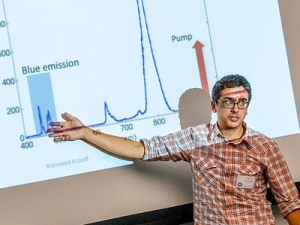
Two state-of-the-art research areas – nanotech and optogenetics – were the dominant theme last Thursday, Sept. 18, as six researchers from UC Berkeley, UC San Francisco and Lawrence Berkeley National Laboratory sketched out their teams’ bold plans to jump-start new brain research.

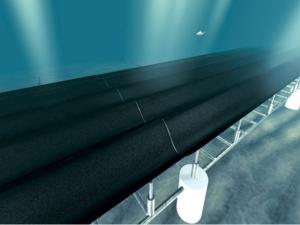
Seafloor carpet catches waves to generate energy
UC Berkeley Professor Reza Alam, an expert in wave mechanics, is looking to harness the power of big ocean waves by using the seafloor “carpet”, which he proposes will convert ocean waves into usable energy.
Teaching
Undergraduate Research [ENGIN 194]
Graduate Ocean Engineering Seminar [ENGIN 201]
Renewable Energy Systems [ENGIN 210A]
Renewable Energy Systems [ENGIN 210A]
Principles of Modern Ocean Engineering [ENGIN 217B]
Principles of Modern Ocean Engineering [ENGIN 217B]
Master of Engineering Capstone Project [ENGIN 296MB]
Fluid Mechanics [MECENG 106]
Ocean Engineering Seminar [MECENG 160]
Group Studies, Seminars, or Group Research [MECENG 298]
Individual Study or Research [MECENG 299]
Supervised Independent Group Studies [MECENG 98]
Supervised Research: Physical Sciences [UGIS 192D]
Master of Engineering Capstone Project [ENGIN 296MA]
Engineering Aerodynamics [MECENG 163]
ENGINEERING AERODYNAMICS [MECENG 263Z]
Group Studies, Seminars, or Group Research [MECENG 298]
Individual Study or Research [MECENG 299]
Supervised Research: Physical Sciences [UGIS 192D]
Fundamentals of Modern Aerodynamic Design and Analysis [ENGIN 247]
Graduate Ocean Engineering Seminar [ENGIN 201]
Principles of Modern Ocean Engineering [ENGIN 217B]
Principles of Modern Ocean Engineering [ENGIN 217B]
Master of Engineering Capstone Project [ENGIN 296MB]
Ocean Engineering Seminar [MECENG 160]
Mechanics of Offshore Systems [MECENG 168]
Mechanics of Offshore Systems [MECENG 168]
Advanced Special Topics in Ocean Engineering [MECENG 292K]
Group Studies, Seminars, or Group Research [MECENG 298]
Individual Study or Research [MECENG 299]
Supervised Independent Group Studies [MECENG 98]
Supervised Research: Physical Sciences [UGIS 192D]