
Research Bio
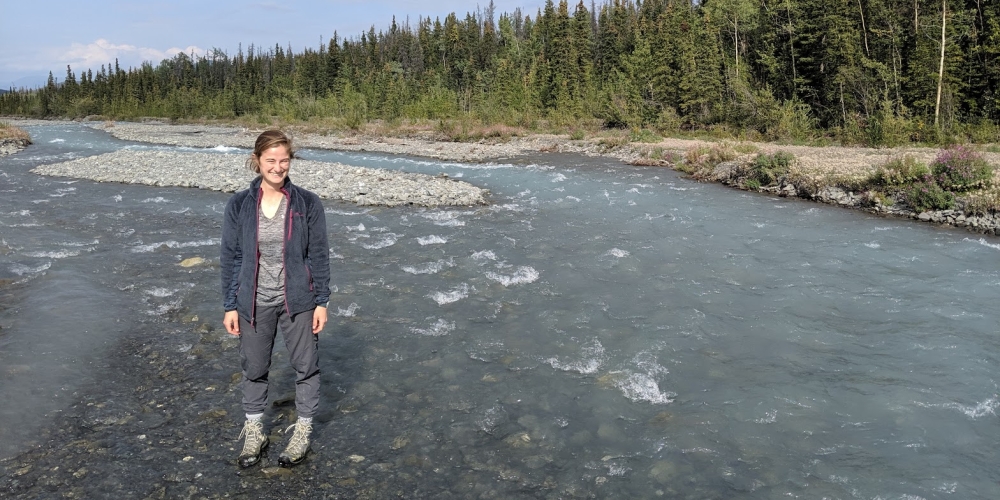
Madison Douglas is an assistant professor in Earth and Planetary Science. Her research focuses on the physical, chemical, and biological processes that have shaped the surface of Earth throughout our planet's history, forming the landscapes we know and love today. Predicting natural hazards such as flooding and debris flows requires understanding the physical processes active in rivers, hillslopes, and coastlines and collaborating with geochemists and biologists. Her work includes traveling to collect samples and measure natural processes as well as running laboratory experiments to make scaled-down versions of these processes using water and sediment. Prof. Douglas's group also quantifies landscape change through time using remote sensing and develops novel numerical models of processes. Her research primarily focuses on landscapes in permafrost environments, since these are rapidly thawing as the climate warms and can release greenhouse gases into the atmosphere. She also conducts research locally in California to understand the effects of vegetation on landscape development. These projects help understand how Earth's surface has evolved from the first expansion of life onto the continents to the present, and to inform landscape management practices for a safe and sustainable future.
Research Expertise and Interest
landscape evolution, permafrost environments, periglacial geomorphology, Earth's surface, sediment transport
In the News

Seven UC Berkeley Faculty Named 2026 Sloan Fellows
Teaching
Geomorphology [EPS 117 - 001]
Geomorphology [EPS 215 - 001]
Research [EPS 280 - 040]
Coastal Processes [EPS 127 - 001]
Research [EPS 280 - 044]
Geomorphology [EPS 117 - 001]
Geomorphology [EPS 215 - 001]
Research [EPS 280 - 040]