
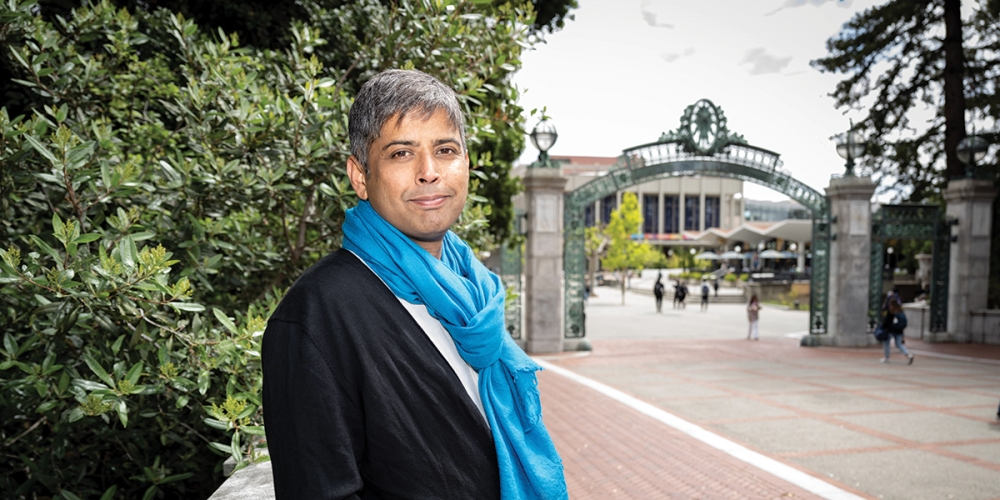
Research Bio
Trained in history (Presidency College; Centre for Studies in Social Sciences, Calcutta) and art history (Maharaja Sayajirao University of Baroda; University of Minnesota), Sugata Ray is a historian of South Asian art and architecture whose work spans the Indian Ocean world from the fifteenth century to the present. Drawing on environmental history, postcolonial geophilosophy, and posthumanist thought, his scholarship examines how ecological change and cultural production have shaped one another and what these intertwined histories reveal about the present climate crisis.
His first book, Climate Change and the Art of Devotion: Geoaesthetics in the Land of Krishna, 1550–1850 (2019), charted how monsoon failures linked to El Niño events during the Little Ice Age shaped painting, architecture, and devotional cultures in northern India. Bringing art history into conversation with theology and environmental history, the book developed geoaesthetics as a framework for understanding how matter and life—both human and more-than-human—are entangled in artistic practice. Climate Change and the Art of Devotion received the Society of Architectural Historians of Great Britain’s Alice Davis Hitchcock Medallion and the American Academy of Religion’s Religion and the Arts Book Award and was a finalist for the PROSE Award in Art History and Criticism.
Ray is currently writing two books. Living with the Animal in Mughal India develops a posthumanist art history of the early modern world by placing Mughal intellectual and visual traditions at the center of debates that have largely privileged European perspectives. Moving from the now-extinct dodo in the emperor Jahangir’s menagerie to an antelope he memorialized near Lahore, the book reconsiders the limits of human sovereignty through the unequal yet intimate relations of wonder, kinship, care, and grief that bind lives across species. Alam-i Nau/New World: Envisaging the Americas in the Indian Ocean World, 1492–1750 traces how plants, animals, and materials from the Americas transformed painting, architecture, natural history, and horticulture across monsoon Asia, situating the ecological and aesthetic histories of the “Columbian Exchange” beyond its conventional Atlantic geography.
From the “effeminate” Buddha in anticolonial art historiography and the political ecologies of prāṇa (vital breath) to avian extinction and the global itineraries of the turkey, Ray’s writings examine the politics of embodiment, the animacy of matter, and the possibilities for a decolonial eco art history grounded in the Global South and the Indian Ocean world. His essays on these themes have appeared in journals including The Art Bulletin, Art History, Journal of Early Modern History, South Asia: Journal of South Asian Studies, and TDR: The Drama Review. His research on the collecting of Islamic art in the United States received the Historians of Islamic Art Association’s Margaret B. Ševčenko Prize. In 2018, he guest edited a special issue of Ars Orientalis on translation and the conceptual vocabularies of art history. Ray has held fellowships and research appointments at the Getty Research Institute, the Kunsthistorisches Institut in Florenz–Max-Planck-Institut, the Social Science Research Council, the Museum of Modern Art’s Mellon-Marron Research Consortium, the University of Sydney’s Power Institute, and the Doris Duke Foundation for Islamic Art, among other institutions.
Ray’s scholarship extends into curatorial practice, art criticism, and public engagement. His curatorial projects include Love across the Global South at the Bernice Layne Brown Gallery, UC Berkeley (2017); Crisis & Creativity, a virtual artist residency at the South Asia Art Initiative (2020); The World Awaits You Like a Garden at Latitude 28, Delhi (2022); and Jīva: A Bestiary for Our Times at DAG, Delhi (2028). His teaching has also fostered student-curated exhibitions at the Berkeley Art Museum and Pacific Film Archive, including Five Tables of the Indian Ocean (2019) and Five Tables of Art & Climate Change (2023). His art criticism has appeared in October, Afterimage, and exhibition catalogs for the Lahore Biennale, Vadehra Art Gallery, and the Art Gallery of New South Wales, among other venues. A frequent speaker on art and climate change, Ray has delivered keynote addresses and invited lectures at institutions and cultural platforms worldwide, including the Lahore Biennale, Princeton, Yale, Harvard, the Getty Center, Asia Society Hong Kong, Humboldt-Universität zu Berlin, the National Taiwan Museum of Fine Arts, and the Guangzhou Academy of Fine Arts.
Collaboration is central to Ray’s research and teaching. With Venugopal Maddipati, he coedited Water Histories of South Asia: The Materiality of Liquescence (2020), an interdisciplinary volume on the cultural lives of water. He organized the 2018 Berkeley symposium “Eco Art History: Genealogies, Methodologies, Practices, Horizons” with Whitney Davis and has cotaught courses on art and ecology with artist Asma Kazmi and geographer Sharad Chari. With Atreyee Gupta, he developed Language of Nature, Language of Culture: Towards a Decolonial Art History (2026–29), a Getty Foundation Connecting Art Histories project that reconsiders the nature-culture binary in art history through site-based laboratories in Kolkata, Delhi, and Berkeley.
Ray’s teaching spans South and Southeast Asian art, global early modern and Indian Ocean art histories, eco art history, collecting and the archive, postcolonial theory, and art historical methods. His doctoral students pursue research ranging from medieval ivory and early modern climate histories to trans-Iberian medicine and colonial Philippine art, while former advisees have secured positions at Reed College and the Thoma Foundation. Beyond Berkeley, Ray serves on several scholarly editorial boards and advises arts organizations, including the Society for Asian Art at the Asian Art Museum, San Francisco.
At UC Berkeley, Ray is a founding member and former Faculty Director of the South Asia Art Initiative as well as Assistant Faculty Director of the Institute for South Asia Studies, where he previously served as Interim Director and Sarah Kailath Chair of India Studies. He is also founding Faculty Lead of the Institute’s Climate Change Initiative and, through service on campuswide committees, has helped shape Berkeley’s sustainability planning, with an emphasis on environmental justice and decolonial approaches to climate action. He holds a 0% appointment in the Department of South & Southeast Asian Studies and is affiliated with programs in early modern studies, Asian and Middle Eastern studies, contemporary India, and migration.
Research Expertise and Interest
climate change, early modern, south asia, southeast asia, indian ocean, art history, environment, globalization, ecology, eco art history, global art history
Teaching
Special Study for Graduate Students in the History of Art [HISTART 299 - 012]
Special Topics in Fields of Art History [HISTART 290 - 002]
Special Study for Honors Candidates in the History of Art [HISTART H195 - 001]
Undergraduate Seminar: Problems in Research and Interpretation: Asian [HISTART 192A - 001]
Supervised Independent Study [HISTART 199 - 002]
Special Study for Graduate Students in the History of Art [HISTART 299 - 012]
Introduction to the Art and Architecture of South and Southeast Asia [HISTART 30 - 001]